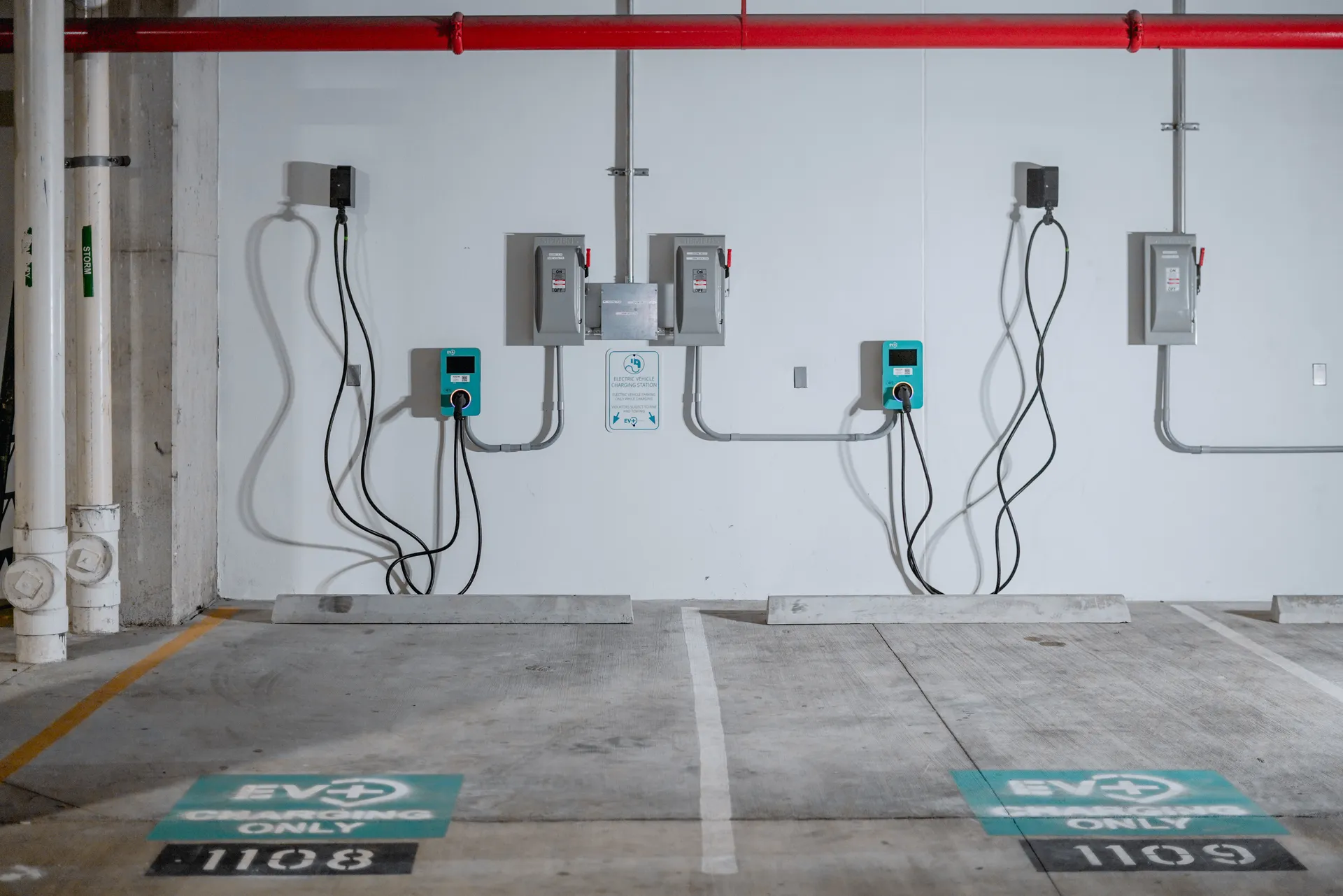
Most properties don't run out of parking spaces before they run out of amps. Here's how dynamic load management (also called dynamic power management or dynamic load balancing) raises the ceiling on an electrical panel a property already has, and what to ask any charging partner that claims to handle it.
The real constraint isn't parking. It's the panel.
Ask any property team that has priced out a multi-charger rollout: the number of chargers a site can install gets set by the electrical panel long before it's set by available parking.
A static, worst-case load calculation (the kind most electrical designs default to) reserves each charger's full rated amperage at all times, whether a car is plugged in or not. Size a panel that way and the utility service upgrade needed to support it becomes one of the largest line items in the entire project. In older buildings, it can become the project-stopper entirely.
Dynamic load management changes the math. Instead of reserving a fixed worst-case share of power for every port, it allocates power across active chargers in real time, based on what's actually plugged in and drawing current at any given moment.
Static allocation vs. dynamic load management
| Approach | How power is allocated | Typical result |
|---|---|---|
| Static, worst-case | Every charger reserves its full rated output at all times, in use or not | Panel sized for a peak that almost never happens in practice, with fewer ports per amp of service |
| Dynamic load management | Power shifts continuously based on which chargers are actually active and how much headroom the panel has | More ports run safely on the same service, with peak draw staying under the panel limit automatically |
Static sizing isn't wrong. It's just wasteful. Ten chargers rated at 48 amps each imply a 480 amp worst case that will almost never actually occur, because it's rare for ten drivers to arrive, plug in, and draw a full charge in the same minute. Dynamic load management uses the gap between that worst case and real-world demand to run more chargers safely on the panel a property already has.
Why this is a capital stack question, not just an electrical one
For a property funding its own installation, avoiding a panel or transformer upgrade is one of the largest single savings available in a commercial charging project.
For a zero-CapEx deployment, the stakes don't disappear; they move. EV+ funds 100% of design, equipment, and installation, so a panel upgrade that load management avoids is capital EV+ doesn't have to spend and risk EV+ doesn't have to underwrite. That's what makes it possible to bring more chargers, and more of the program's value, to a property without asking the property to absorb the cost of its own electrical limitations.
Panels don't get bigger between the time a charging partner designs a system and the time a utility completes an upgrade. The design either works with what's there, or it doesn't, and every upgrade in the critical path adds months.
How the industry talks about load management
Every operator in this category is solving the same panel capacity problem, and most now lead with it. The category generally frames load management around a few standard outcomes:
- Real-time energy control
- Cost optimization that avoids unnecessary panel or utility upgrades
- Overload protection that keeps a site's draw within its service limits
These are usually delivered through some combination of a monitoring gateway, a meter, and cloud-connected software. Some providers go further and publish a headline multiplier, a stat like "up to Nx more chargers on the same panel." Those numbers are worth asking about: what assumptions drive the multiplier, and how does it hold up across your actual parking layout and expected utilization patterns?
The underlying mechanics (real-time power metering, dynamic allocation across active sessions, automatic overload protection) are fairly consistent across commercial-grade systems. What differs is how well those mechanics are integrated into the full deployment and how invisible they stay once the system is live.
How EV+ approaches it
EV+'s load management runs as a standard part of every deployment, not an upsell. It distributes power across every active charger in real time, which is what lets a property install significantly more stations than a static calculation would allow, without expanding electrical capacity.
The system keeps total load safely within panel limits, protects against overload, and makes sure every driver still gets the charge they need, automatically, with no property staff watching a dashboard or manually adjusting anything.
Designed to be invisible
A load management system that needs someone on site to watch a dashboard and step in during peak hours isn't removing operational burden; it's relocating it. EV+'s approach is built to stay invisible to the property team, consistent with the fully managed, hands-off model behind everything else EV+ runs.
The panel is the plan
Any property evaluating a multi-charger rollout should ask a prospective charging partner exactly how its load management works, not just whether it has some.
For a deeper look at what actually drives commercial charging costs (panel upgrades included), see How Much Does It Cost to Install an EV Charger? (2026 Commercial Property Guide). To see where load management fits inside EV+'s full technology stack, visit the Technology page.
Ready to find out how much capacity your existing panel actually has? Talk to EV+ about a zero-CapEx deployment.